
Ask the warehouse manager how many units are on the floor. Ask sales how many are available to promise. Ask purchasing when the next 500 land. Ask finance what the month-end value shows.
You will get four numbers, and quite possibly none of them will match what's physically in the building right now.
For a growing distributor, manufacturer, or multi-location business, this isn't a symptom of bad counting. It's what happens to a single number as it travels through a business with more than one location, more than one team, and more than one system between them. The stock itself rarely goes missing. The story about the stock gets rewritten at every handoff, and nobody notices until an order can't be fulfilled.

- A single inventory number is a fiction. "1,000 units" collapses at least four different questions (physical, available, committed, damaged) into one figure, which manufactures false confidence.
- Inventory doesn't break in one place, it breaks at handoffs. Receiving, inter-location transfers, order commitments, returns/rejects, and dispatch are the five points where physical stock and recorded stock quietly diverge.
- "What we have" and "what we can sell" are different questions. Physical stock minus commitments, damage, holds, and in-transit stock is the number that actually matters for fulfillment.
- The diagnostic question isn't "is the number wrong," it's "where did it go wrong." Knowing you're off by 200 units is nearly useless without knowing which stage of the process caused it.
- A 20-SKU accuracy test surfaces the pattern. Compare system vs. physical count on your top 20 SKUs by value/volume, then trace every mismatch back to its origin (receiving, transfer, picking, dispatch, returns, data entry). Repeat mismatches = a process gap, not a counting problem.
- The real cost shows up downstream. Untrusted numbers lead to excess safety stock, overpromising by sales, duplicate purchasing, warehouse teams reconciling instead of moving goods, and finance seeing problems after they've already happened.
- Fix the flow before buying new software. Trace one SKU end-to-end (PO → receipt → warehouse → transfer → sales order → pick → dispatch → delivery → return) and ask at each step whether the physical movement automatically creates the right record. If the answer is "someone updates it later" via Excel, WhatsApp, or a phone call, that's the actual problem, not the ERP.
- The goal is visibility, not more counting. Good inventory management means every movement is visible, connected, and traceable back to its source, so no one has to ask "can someone check if we have this?"
Key takeaways
Buying
Five places where the story changes

Follow one pallet through a typical order cycle and count how many times its "official" quantity can quietly diverge from what's actually there.
Receiving. The purchase order says one number. The truck brings another. A short delivery, a damaged carton, or a receiving clerk logging the GRN two days late. Each of these plants a discrepancy before the stock has even reached a shelf.
Transfers. A warehouse ships 100 units to a second location. For the hours or days it takes the receiving site to confirm the stock, those 100 units effectively exist twice: once in the system that sent them, once in the truck that hasn't arrived yet. Any business running more than one warehouse lives with this gap permanently.
Commitments. The system reports 1,000 units on hand. Sales has already promised 300 of them to customers who haven't shipped yet. So the number everyone quotes is 1,000, but the number the warehouse can actually move is 700. Nobody notices the gap until a picker goes looking for stock that was already spoken for.
Returns and rejects. A product comes back from the market. Is it added to available stock, held for inspection, or written off as damaged? If that decision isn't made explicitly and immediately, the system keeps counting stock the business can no longer sell. That habit gets expensive fast for dairy and frozen goods, where a few missed days of shelf life turn "available" into "unsellable."
Dispatch. Fifty units are picked. Fifty are invoiced. Forty-seven arrive. The missing three are now somewhere between the loading dock, the delivery route, and the customer's signature. By the time anyone notices, the transaction is old news.
Physical stock and sellable stock are different questions
"How many units do we have" is really several questions wearing one costume:
- What is physically present, right now, in any location?
- What is available to promise to a new customer?
- What is already committed, in transit, or awaiting inspection?
- What is damaged, expired, or otherwise unsellable no matter what the ledger says?
A single inventory figure collapses all of this into one number, and in doing so manufactures a kind of confidence the business hasn't actually earned. A system that reports "1,000 units" without separating available, reserved, in-transit, and damaged stock isn't wrong exactly. It's just answering a question nobody asked.
Three questions worth answering without a phone call
A useful test of any inventory setup: can leadership answer these on demand?
What do we physically have, right now? Not last week's cycle count. Not a spreadsheet someone updates on Fridays.
What can we actually sell? Physical stock and sellable stock are rarely the same figure once commitments, damage, and holds are accounted for.
Where is the gap coming from? Knowing the system is off by 200 units is nearly useless on its own. Knowing it happened at receiving, or in a transfer that was never confirmed, is what actually gets fixed.
Most operations teams can answer the first question with some effort, the second with more effort, and the third almost never, because the systems that record inventory rarely record why it changed.
A twenty-SKU test worth running this week
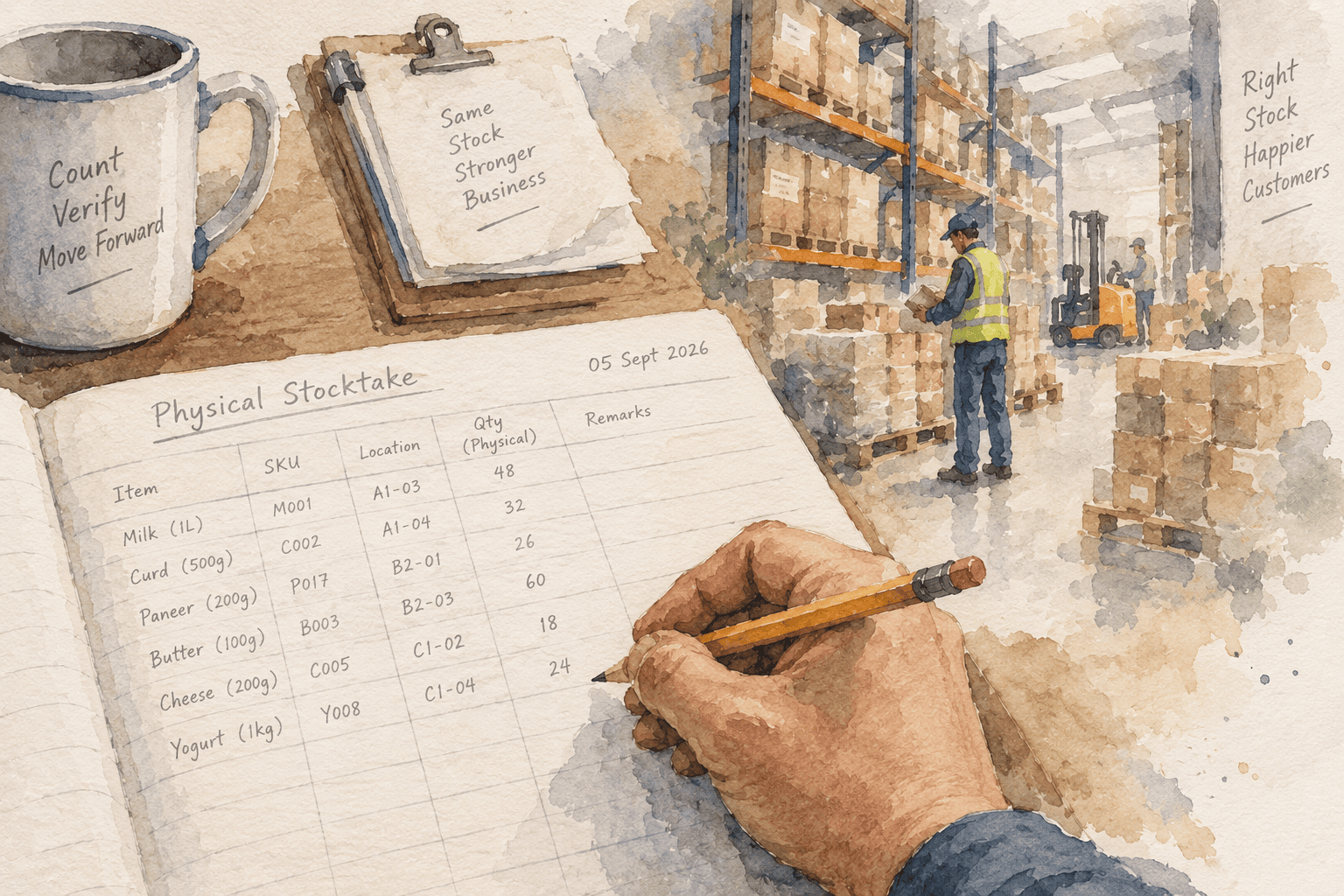
Pick the twenty SKUs that matter most, by value or volume. For each one, compare the system's quantity against a physical count, then calculate:
Inventory accuracy = correct records ÷ total records × 100
The percentage makes a decent headline, but the real diagnostic is the next question, asked for every mismatch found: where did this one happen? Receiving, transfer, picking, dispatch, returns, a data-entry slip, a master-data error?
If the same category of mismatch keeps showing up, the business has found a process gap, not a counting problem, and no amount of recounting will close it.
Before buying another system
Trace one SKU through its full journey: purchase order, receipt, warehouse, transfer, sales order, pick, dispatch, delivery, return. At each handoff, ask one question: does the physical movement automatically create the correct record, or does someone have to go back and fix it afterward?
If the honest answer involves Excel, WhatsApp, a phone call, or someone checking and updating it later, and that happens more than once along the chain, the business has found something bigger than an inventory accuracy issue. It has found the exact places where visibility quietly breaks down, one handoff at a time.
The number that matters
Every ERP can be configured correctly. Every warehouse team can be working carefully. And the inventory report can still be wrong, because accuracy isn't a property of any single screen or shift. It's a property of everything that happens to a unit of stock between the moment it's ordered and the moment it's paid for.
Counting more often won't fix that. Making every movement visible, connected, and traceable back to its source will.
Scaling a food, dairy, or frozen distribution business and want a clearer view across your warehouse, fleet, and sell-through data? Connect with Hopnet for a free strategy session and a roadmap tailored to how your supply chain actually runs today.